On Monday, the Senate State Affairs Committee hosted a hearing for Sen. Charles Perry’s controversial Senate Bill 3, which would ban THC and nearly all other cannabinoids. The committee also heard SB 1505, Perry’s bill that makes changes to the Compassionate Use Program.
The hearing attracted a large turnout, with over 170 individuals registering to testify, highlighting the intense public interest and industry stakes. Testifying witnesses included regulators, hemp business owners, employees, consumers, cannabis attorneys, medical professionals, and law enforcement. All witnesses are listed here, including the following individuals who were invited by the committee to testify first:
Invited Testimony: Senate Bill 3
- Dr. Timothy Stevenson, Consumer Protection Division (Dept. of State Health Services)
- Major Mark Melson, Criminal Investigations Division (Texas DPS)
- Chief Brady Mills, Crime Laboratory Division (Texas DPS)
- Chief Steve Dye, Allen Police Department and Texas Police Chief’s Association
- Narcotics Sergeant Justin Arsenault, Allen Police Department
- Sheriff Brian Hawthorne, Sheriffs Association of Texas
- Dr. Lindy McGee, Texas Medical Association
Invited Testimony: Senate Bill 1505
- Jervonne Singletary (Goodblend)
- Nico Richardson, Nico (Texas Original Compassionate Cultivation)
- Chief Wayne Mueller (Texas DPS)
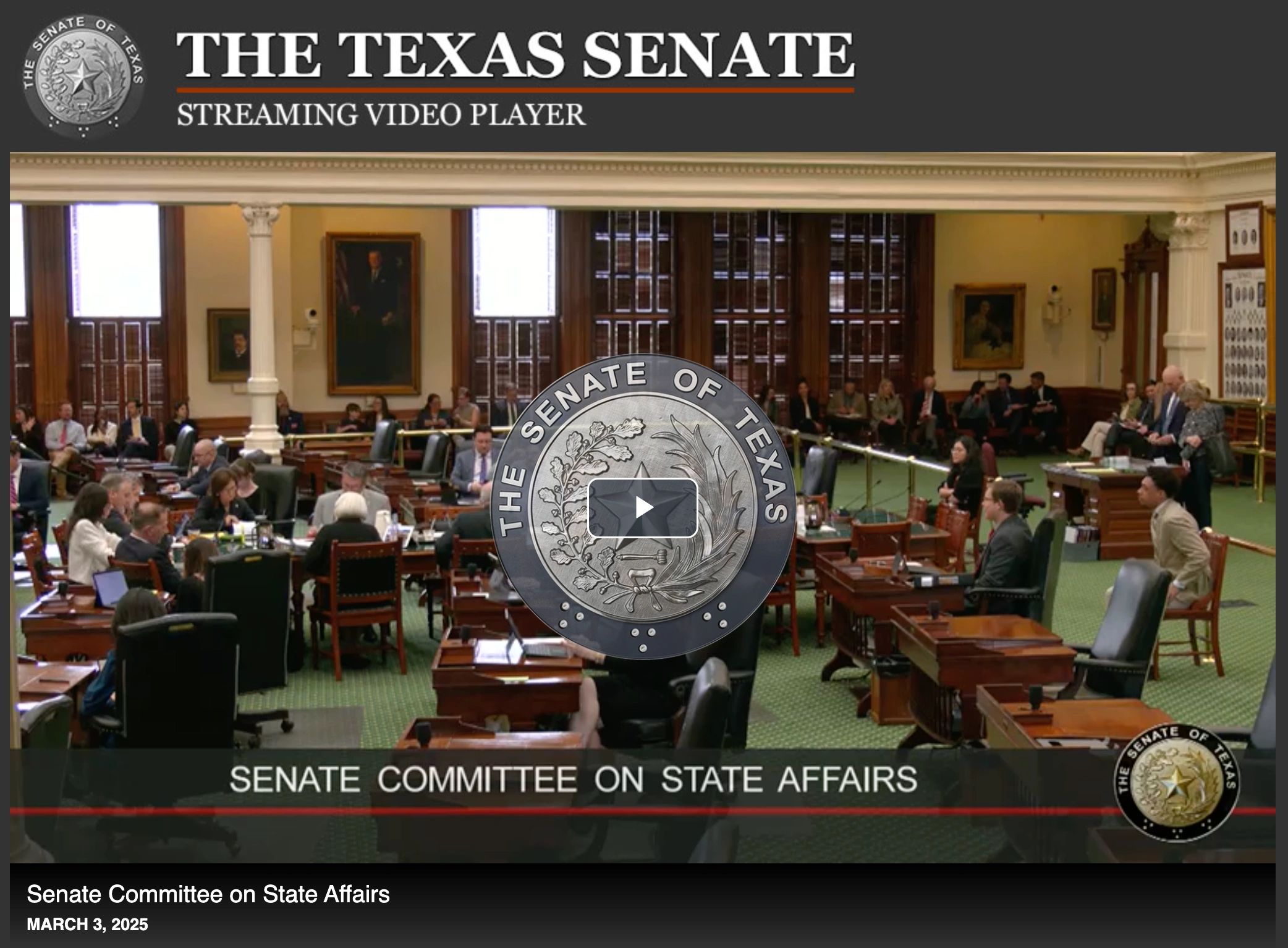
Watch invited testimony here:
Public Testimony (1:44:40):
The hearing was covered by the Texas Tribune, Houston Chronicle, CBS Austin, Fox 7, and Marijuana Moment.
Here is the Senate recap of hearing and here is a link to the bill text and resource documentation.
SB 3: The Push to Ban All THC Products
Authored by Senator Charles Perry, SB 3 seeks to ban all consumable hemp products containing THC and most other cannabinoids. The bill would allow only CBD and CBG products but would restrict them to consumers 21 and older. Perry argued that the hemp industry had failed to self-regulate and called its participants “untrustworthy.”
The bill also proposes a $10,000 annual licensing fee for manufacturers and a $20,000 per location annual fee for retailers. Additional provisions include strict packaging and labeling requirements, banning marketing that implies medical benefits or that could appeal to minors. Law enforcement agencies, including the Texas Department of Public Safety (DPS), testified in favor of SB 3, asserting that the current law is difficult to enforce and that the bill would streamline THC testing and evidence collection.
SB 3 carries a negative fiscal note of over $27,000,000, plus an unknown cost to our criminal justice system due to the massive expected influx of arrests and prosecutions. Of course, this is in addition to the devastating human cost of saddling tens of thousands of Texans with criminal records for the possession of federally legal hemp products.
A Contentious Hearing and Emotional Testimonies
The hearing quickly became one of the most heated legislative debates of the session. Supporters of SB 3—including representatives from law enforcement—were given the floor first, with all committee members present and engaged. However, as opponents of the bill began their testimonies, committee members gradually cycled out, and some appeared distracted, prompting frustration among witnesses.
The first person to testify in opposition was Elizabeth Miller, who urged the committee to use medical terminology rather than “drug dealer” rhetoric when discussing cannabis. Her testimony drew applause from the gallery, leading Chairman Bryan Hughes to threaten to clear the room. Later, Piper Lindeen, a caregiver and mother, delivered an emotional testimony, expressing anger over the absence of key committee members while she spoke about her family’s experience with medical cannabis. The audience again erupted in applause, and this time, the chairman followed through on his threat, clearing the gallery for about 30 minutes before allowing the public to return.
One of the most surprising moments came when Sergeant Justin Arsenault from Allen, Texas, testified that street dealers are no longer selling cannabis products because they are available legally through regulated hemp retailers. This underscores one of the core arguments against SB 3—a legal market for THC disempowers criminal drug dealers, making our communities safer.
SB 1505: Changes to the Texas Compassionate Use Program
Also on the table was SB 1505, another bill authored by Senator Perry, which aims to expand the Texas Compassionate Use Program (TCUP). The bill proposes increasing the number of licensed medical cannabis dispensaries from three to six, broadening product options to include inhalers and vapes, and placing a 90-day supply limit per prescription with a cap of 5 mg THC per dose.
Chairman Bryan Hughes’ decision to mix testimony from both bills blurred the lines, making it difficult to focus on either bill independently. Some supporters of SB 1505 also expressed concern that SB 3 could hurt patients by limiting their options outside of the medical system.
A Deeply Divided Future for Cannabis in Texas
The hearings on SB 3 and SB 1505 underscored the sharp divide in Texas’ approach to cannabis policy. While law enforcement officials and conservative lawmakers push for tighter regulations and outright bans, business owners, medical patients, and consumer advocates argue that prohibition would only drive THC sales underground and limit access to beneficial cannabis products.
With tensions high and both sides deeply entrenched, the fate of Texas’ hemp and cannabis industry remains uncertain. The hearings may be over, but the fight over SB 3 and SB 1505 is far from settled.